
If you’ve scrolled past headlines about churches marching in Mizoram, NGOs sounding alarms, and the BJP fumbling its own messaging, you’ve probably wondered what the FCRA bill actually does and why it’s suddenly the center of a national argument.
Here’s the short version: the Foreign Contribution (Regulation) Act, or FCRA, governs how NGOs, charities, and other organizations in India can receive and use money from abroad. The 2026 amendment, along with a companion gazette notification issued on June 22, tightens the rules around how that money is tracked, reported, and controversially, what happens to assets built with it if an organization’s foreign-funding license lapses.
- If you’ve scrolled past headlines about churches marching in Mizoram, NGOs sounding alarms, and the BJP fumbling its own messaging, you’ve probably wondered what the FCRA bill actually does and why it’s suddenly the center of a national argument.
- A Law With a Long, Messy History
- What the 2026 Amendment Changes
- The Proselytization Confusion
- Why Institutions Might Resist Accountability
- The Bigger Media Angle
- So, Is This About National Security or Civil Liberties?
- The Honest Advice
A Law With a Long, Messy History
FCRA isn’t new. It dates back to 1976, during the Emergency, when Indira Gandhi’s government moved to control foreign money flowing into Indian politics and civil society -ostensibly to block outside interference, though the law’s origins are themselves politically tangled. It’s been renamed and reworked more than once since, including a significant tightening under P. Chidambaram after the Kudankulam nuclear protests, which were partly funded through church channels.
The core argument for updating it again in 2026 is a familiar one: the law hasn’t kept pace with how money and information actually move now. Rules written before UPI, before the smartphone era, don’t map well onto a world of shell companies, instant transfers, and funding routed through websites rather than traditional NGOs.
What the 2026 Amendment Changes
Strip away the noise, and the bill’s substantive changes are narrower than the debate around them suggests:
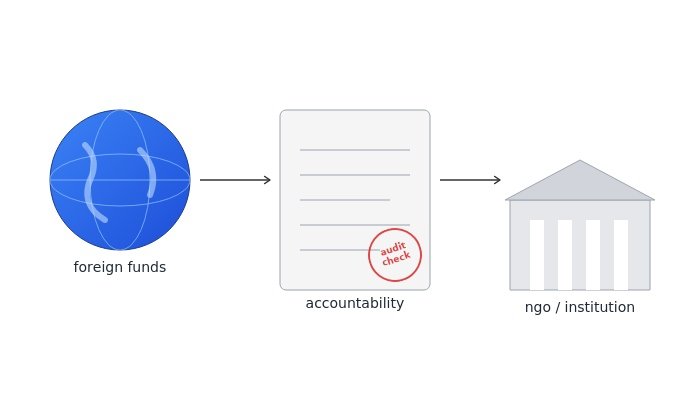
- Organizations receiving foreign funds have to clearly state their purpose and show they’re sticking to it.
- Spending has to correspond to actual, verifiable activity -not just administrative costs.
- There’s a new accounting and due-diligence requirement, including scrutiny of who’s actually behind the money (to catch funds routed through shell corporations).
- Most contentiously, if an organization’s FCRA registration lapses and it’s found to have violated the terms of its foreign funding, assets built using that money can be taken over by the government under a new “designated authority.”
That last point is where a lot of the backlash concentrates. Picture an NGO that builds a community center partly with foreign funds and partly with domestic donations. If the foreign-funding side of that project is found non-compliant, the entire property can potentially be seized -a prospect that understandably worries organizations operating on thin margins and imperfect paperwork.
The Proselytization Confusion
A lot of the religious backlash, particularly from church groups in Kerala, Mizoram, and Nagaland- centers on the phrase “excluding proselytization,” which appears in a couple of sub-clauses of the gazette notification. Critics of the bill’s rollout argue this phrase has been badly explained, and that public understanding of it has outpaced what the text actually says. Read closely, the exclusion applies to only two or three narrow sub-categories, while other sections explicitly protect religious activity, building churches, mosques, and community halls; imparting religious education; running langars. The core complaint from defenders of the bill is that this got muddled in translation and public messaging, including from the government’s own communications machinery, which drew criticism for letting misinformation spread rather than clarifying the law.
Why Institutions Might Resist Accountability
One read of the pushback voiced strongly in discussions defending the bill is less about religious freedom and more about financial opacity. The argument goes: some organizations, religious and secular alike, have operated for years with minimal accounting oversight, and a due-diligence requirement threatens that. Under this framing, the resistance isn’t principled objection to state overreach so much as reluctance to open the books.
That’s obviously a contested claim, and NGOs, church groups, and civil liberties advocates would frame it very differently, as a law that hands an expansive, poorly defined “designated authority” the power to seize community assets over technical violations, with a chilling effect on legitimate charitable and religious work. Groups fear that vague terms like “purpose” and “compliance” leave enormous discretion in the hands of whichever government is in power, and that this discretion could be used selectively against organizations the state finds politically inconvenient.
The Bigger Media Angle
One of the more interesting threads in this debate is less about NGOs and more about news. Indian newspapers can’t receive foreign funding, but websites can, and increasingly, websites are where people actually consume news. That creates a lopsided system: legacy print media is walled off from foreign money, while digital outlets aren’t necessarily subject to the same scrutiny. Since protests are often triggered by news coverage rather than the other way around, some argue this asymmetry deserves at least as much attention as the NGO provisions, and that the current bill doesn’t fully address it.
So, Is This About National Security or Civil Liberties?
Neither, really -at least according to defenders of the bill, who frame it as being about accountability and transparency: making sure organizations use foreign money for what they say they’re using it for, and can prove it. Whether you find that framing convincing, or whether you see the asset-seizure and vague-compliance provisions as a bigger civil-liberties problem than that framing allows, depends a lot on how much you trust the “designated authority” that would enforce it and that’s precisely the fault line running through this debate.
The Honest Advice
Whatever side of this you land on, the most useful thing anyone can do is skip the secondhand takes, including this one and read the primary sources: the FCRA (Amendment) Bill, 2026, and the gazette notification issued on June 22, 2026. Both are public and searchable. In an environment this politically charged, forming your own view after reading the actual text is worth more than any single explainer.